
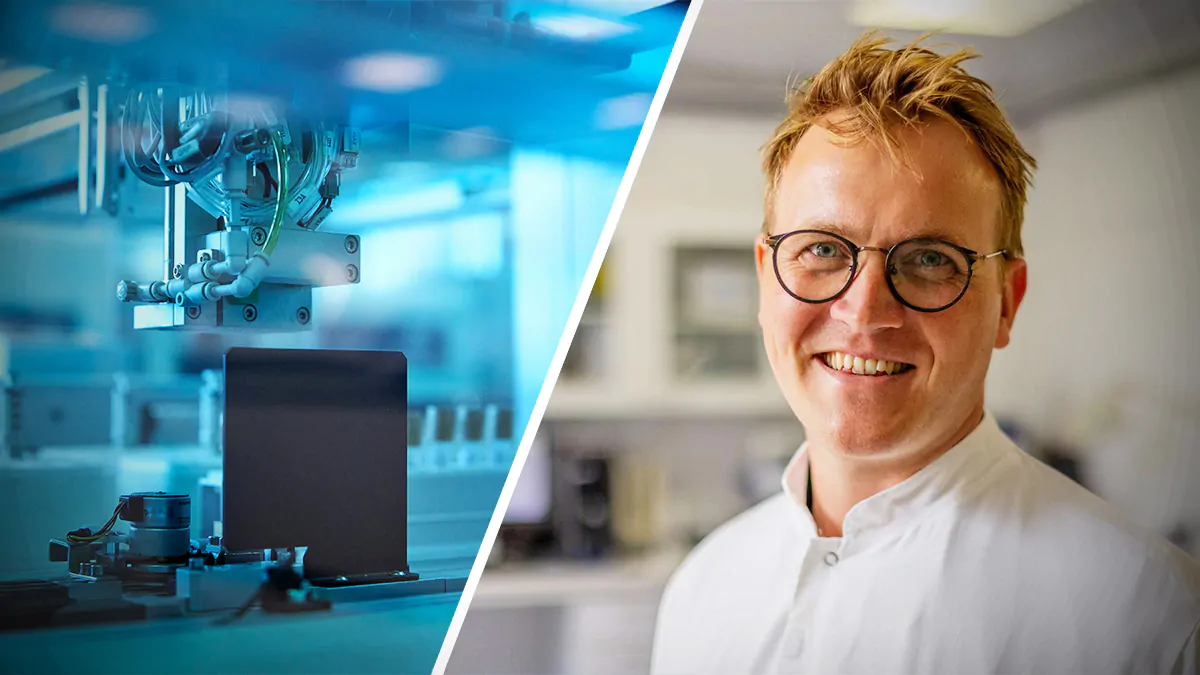
How much progress have we made with PFAS substitution? What are the obstacles, and what is needed to speed up the process? ChemSec asked Dr. Emil Damgaard-Møller, a specialist chemicals consultant at the Danish Technological Institute (DTI), who has spent many years working closely with industry on substituting PFAS with safer alternatives.
Emil, is it correct to say that phasing out PFAS is a terrible headache?
It is more manageable than many assume. In a great many cases, PFAS alternatives can be developed or implemented, provided a serious effort is put in. That is the key caveat. Substitution rarely happens by simply pulling a ready-made replacement off the shelf, it usually takes real engineering work, testing, and time.
It is also true that the alternative does not always match PFAS on every parameter. Sometimes you have to accept a somewhat lower performance, or a higher degree of maintenance. But not always and, as I’ll come back to, substitution can just as easily lead to a better product.
So for most PFAS uses, substitution is not primarily a technical problem, it is an economic problem and a knowledge problem. Of course, there are cases where substitution is not currently possible, or where it remains highly challenging. But in my experience, these are more often the exception than the rule.
‘For most PFAS uses, substitution is not primarily a technical problem’
Surely many in industry would disagree?
What we are dealing with is the legacy of more than 50 years of product development built around the availability of fluoropolymers and other PFAS.
These materials have offered an unusually attractive combination of performance, versatility, and cost. PFAS are not cheap as such, but they are by far the best value-for-money option for many applications, and they come with a high safety margin in terms of performance. That is something companies value enormously: you can specify a PFAS-based material and be confident it will do the job under a wide range of conditions. Industry has therefore designed products, processes, and supply chains around them.
That is why PFAS are so deeply embedded in products today. But there are many cases where substitution is possible and viable alternatives exist.
For example, the wristband on my smartwatch is made of FKM, a fluoroelastomer. The very same material is used as sealing in highly aggressive chemical equipment, in combustion engines, and in tapping equipment, it is essentially the go-to material whenever you just want to be sure it works. In many of these cases, the makers have reached for PFAS-based materials because they assume these are the best option — not because no alternatives exist.
Sure, PFAS are versatile and historically cheap. But that is not the same as saying that they are indispensable in most applications.
What is your experience of working with industry on this issue?
At Danish Technological Institute (DTI), we have developed a textile impregnation spray that is water- and oil-repellent, and completely PFAS-free. It is receiving strong interest from industry. We are also seeing promising work on alternatives for, e.g., fuel cells, battery binders, artificial veins, and gaskets in dynamic applications.
Danish company CeramicSpeed has created a new bearing as part of a deliberate effort to phase out PTFE. The new solution has 30% lower friction than the previous PTFE-based version, has a longer lifetime and has strengthened CeramicSpeed’s competitive position in the market.
This illustrates an important point: when companies seriously engage in substitution, they often do not just replicate the old solution. They revisit what the product actually needs to do. And in many cases, that can lead not only to substitution, but to performance improvements.
(Interview continues below…)

So what are the actual barriers to substitution?
In my view, they are primarily twofold: economics, and lack of structured knowledge.
First, the economic barrier. For many companies, especially small and medium-sized enterprises, the risk is difficult to justify if there is no clear market signal that PFAS-free solutions will be rewarded.
We see the same pattern in our recent work at the DTI. Companies that have already worked with PFAS substitution have mainly been driven by environmental and health concerns. Very few have had a direct economic incentive to do so. That is important, because it shows that the market, on its own, is not yet driving substitution at the pace that is needed.
Second, the knowledge barrier. More than half the companies we surveyed report that they have limited or no internal knowledge of chemical substitution. That is a profound challenge.
Today, relevant knowledge is fragmented across patents, scientific literature, supplier documentation, regulatory files, and company experience. As a result, when someone says “there is no alternative”, this often means that no alternative has yet been identified, validated, or made visible to the right decision-makers.
Can you give a concrete example?
There is a common narrative in industry that fluoropolymers are necessary in implantable medical devices, and that removing them would create unacceptable risks for patients. But when we examine the evidence more closely, the picture becomes more nuanced.
In the case of hernia meshes, for example, more than 80% of products in use today are based on polypropylene and polyester — not PFAS materials. That does not mean fluoropolymers are irrelevant in every medical context. But it does mean we need to test broad claims of indispensability against the evidence.
For many PFAS applications, the relevant substitution knowledge already exists in fragmented form. We have identified more than 1,600 scientific articles and more than 3,000 patents on hernia meshes. With modern AI tools, it is now possible to collect, structure, and compare this information in a systematic way.
‘For many PFAS applications, the relevant substitution knowledge already exists’
In your view, how can we speed up substitution?
Without clear regulatory and market incentives, substitution will remain limited. Phasing out PFAS must become the profitable option.
A useful comparison is the development of lithium-ion batteries. At the beginning, costs were very high because production volumes were low. As demand increased, scale increased. As scale increased, costs fell. And as costs fell, demand increased further. This dynamic is known as learning-curve effects, the more we produce, the cheaper and better it gets. That is how to accelerate an innovation curve.
For PFAS alternatives, we are still at the beginning of that curve in many sectors. So, I would put it very simply: We need to make doing the right thing the profitable option.
That requires three things:
- Clear legislation.
- Predictable timelines, so that companies can invest with confidence.
- Shared infrastructure for knowledge, testing, and substitution evidence.
That is how we can accelerate substitution where it is possible, focus attention where it is genuinely difficult, and avoid confusing habit or convenience with true necessity.
For part 1 of this series – professor Hans Peter Arp on the scale of the PFAS problem – click here


